PROOF_IS_PLACEHOLDER = false — before this page is public.Approve the story.
Then build the deck.
Every other tool is one-shot: describe, generate, then fix. The expensive mistake isn’t a crooked logo. It’s forty slides off a misread story.
Built for deal teams
1
cheap artefact approved before the expensive one is built
10
institutional palettes, or extract your own template
Rendered
and inspected before a job reports done
Every deck
change recorded with the instruction behind it
Measured in the product, not projected. Customer counts appear here once there are customers to count.
The approval step
The plan screen is the product.
Ask for a pitchbook, get an outline. Reorder it, cut it, argue with it. Then it composes.
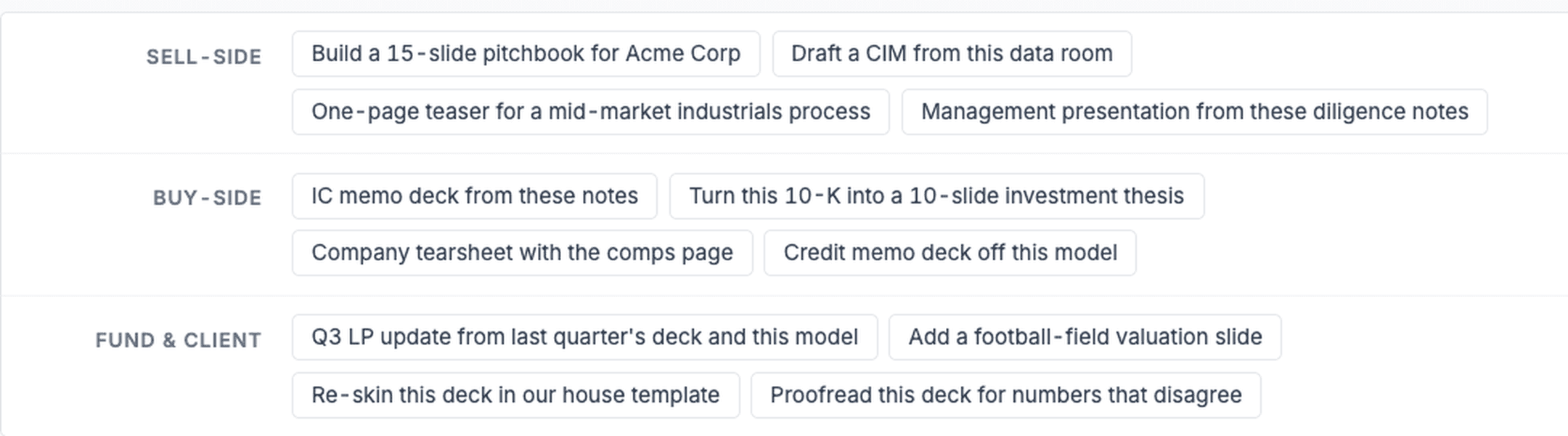
Approve, then compose
The planner returns an outline and stops. Nothing expensive runs until you agree.
Checked by looking at it
We render the deck and look at it before handing it over. Overflow, dead space, bad contrast.
On-brand by construction
House style goes in at build time. Nothing to snap into compliance afterwards.
House style
On-brand by construction.
Everyone else snaps a finished deck into compliance. We put the palette and the template into the build, so there’s nothing to correct.
What people say
The people who sign off the deck like it most.
I used to find out the story was wrong on page thirty, at midnight. Now I disagree with an outline for four minutes and the deck gets built once.
Every deck comes out in our template. Nobody on my team has opened the brand guidelines PDF in months.
The approval step sounds like an extra click until you count how many decks you've thrown away.
Honest comparison
What we do, and what we don’t.
Everyone sells on-brand and traceable. Nobody sells the step before either.
| Capability | pptx-ai | Hebbia, Auxi, Gamma, Prezent |
|---|---|---|
| Approve the storyline before slides are built | Yes | One-shot: describe, generate, then fix |
| House style applied at build time | Yes | Snapped on afterwards as a compliance pass |
| Deck rendered and inspected before completion | Yes | Ships whatever it generated |
| Deck-level audit trail | Yes | “A file was produced” |
| Live market data / research corpus | No | PitchBook, Capital IQ, FactSet |
| Template governance at enterprise scale | No | Prezent's product, 35k templates |
The leaders embed in PowerPoint and inherit its muscle memory. An add-in operates on a deck that already exists — exactly the point at which a storyline mistake has already been paid for.
Customer stories
What changes when the story is agreed first.
3 days
saved per pitchbook
Three days off every pitch cycle
Approving the storyline first meant the team stopped building forty slides against a thesis the MD hadn't seen.
Read the story0
manual re-skins last quarter
On-brand without a compliance pass
House style injected at build time replaced a formatting checklist nobody enjoyed running.
Read the story4×
faster to first draft
CIMs out in ten days, not six weeks
A data room in, an approved outline, then a composed book — with the sources attached to every job on record.
Read the storySecurity
Built for people who have to stand behind the pack.
Client material leaves the building with your name on it. Every deck change is on the record — which job ran, on whose instruction, and from which sources.
Tenant isolation on every route
Every API route pulls org_id off the authenticated user; data is scoped to your organization at the query, not the application layer.
Deck-level audit trail
Every deck change records which job ran, on whose instruction, from which attached sources, and whether it landed.
Your deck is not a training set
Your decks and source documents are used to answer your prompts and nothing else. No training on customer data.
Scoped API keys
Machine access runs through revocable, org-scoped keys, metered and logged like any other actor.
On the roadmap, not yet certified
Who it’s for
From one deck to a house standard.
Solo banker
Turn a filing and a model into a book without waiting on a designer.
Start freeDeal team
One thread per deck, so the storyline is agreed once and built once.
Start freeFirm
House style enforced at build time, plus the trail of who asked for what.
Talk to usResources
Win more of the work you already pitch for.
6 min read
The deck you threw away
Forty slides built off a misread story, found the night before. What that actually costs, and where it gets decided.
5 min read
More pitches out the door, more mandates won
What happens to win rate when the constraint on pitching is judgement rather than production time.
8 min read
Why the storyline has to be approved first
Every deck tool automates the formatting half. The expensive half is the argument, and it's decided in ten minutes.
As seen in
Questions we get asked
Is this a PowerPoint add-in?+
No. Auxi and the other add-ins operate on a deck that already exists — which is after the expensive mistake has been made. We work on the storyline first, then compose. You get a real .pptx out whenever you want one.
What exactly do I approve?+
An outline: the slide order, what each slide argues, and its title. The planner stops there and waits. Nothing expensive runs until you have agreed what the deck says.
Can it use our template?+
Yes — extract the style from a deck you already send to clients, or pick from ten institutional palettes. It is injected at build time, so slides are drawn on-brand rather than corrected into compliance afterwards.
Do you check the deck before handing it over?+
The produced file is rendered and visually inspected before the job reports done — overflow, dead space, unreadable contrast. Generation is not the last step.
Do you have a research corpus or market data?+
No. Hebbia and Rogo have PitchBook, Capital IQ and FactSet. We read the filings, models and notes you attach, and we would rather say so than imply otherwise.
Ask for a pitchbook.
Read the outline first.
That pause is the whole pitch. Everything after it is formatting.
Start a deck